Browser Bridge Building & Demolition Guide: Triangle Trusses, Stress Lenses & Load Paths
Rectangles and unsupported road decks collapse under moving loads because four-bar joints shear into parallelograms without bending a single beam. Locking every span into equilateral triangles converts deadly bending torque into pure axial compression along top chords and tension along bottom chords—doubling load capacity under strict material budgets.
How to Build Under-Budget Spans That Survive Heavy Crossings in Bridge Chaos
-
1
Lay a Slightly Cambered (Upward-Arched) Road Deck First
Instead of drawing a dead-flat horizontal road between two cliffs, arch the center 5–8% higher than the anchor pins so vehicle weight pushes outward into the rock walls.
-
2
Triangulate Every Road Joint Using Equilateral 60° Struts
Connect each road node into overhead Warren or Pratt triangles (Key 1–4 materials). Avoid shallow, flat triangles (< 25°) which multiply internal joint tension.
-
3
Anchor Diagonal Under-Struts Into Lower Cliff Pin Nodes
If a canyon wall offers lower red anchor pins beneath the roadway, brace diagonal compression legs from those lower pins up to the 1/3 and 2/3 span nodes.
-
4
Watch Joint Red-Shift During Test Runs & Reinforce Only the First Failing Node
If a bridge fails, press Z (Undo) rather than erasing everything (
E). Reinforce the single joint that turned bright red first—collapses almost always propagate from one weak pin.
Why Squares Collapse and Triangles Hold: 2D Rigid-Body Joint Physics
Physics engines in HTML5 engineering puzzles like Bridge Chaos simulate joints as pinned hinges connected by elastic springs (Hooke’s Law). If you connect four beams into a square box and drive a truck onto the top edge, none of the four beams need to stretch or compress for the box to flatten sideways into a diamond—so the square folds instantly under almost zero load!
A triangle is the only polygon in 2D geometry whose interior angles cannot change without lengthening or shortening at least one side. When you build a Warren Truss (alternating equilateral 60° triangles above the roadbed), downward vehicle weight pulls the bottom road segments in tension while squeezing the top horizontal spine in compression. Because the load distributes axially across every connected triangle simultaneously instead of bending a single joint, a lightweight triangulated timber bridge routinely holds 400% more weight than a solid double-layered rectangular road.
Reading the Stress Lens in Reverse Builder: Top-Down Zero-Load Demolition
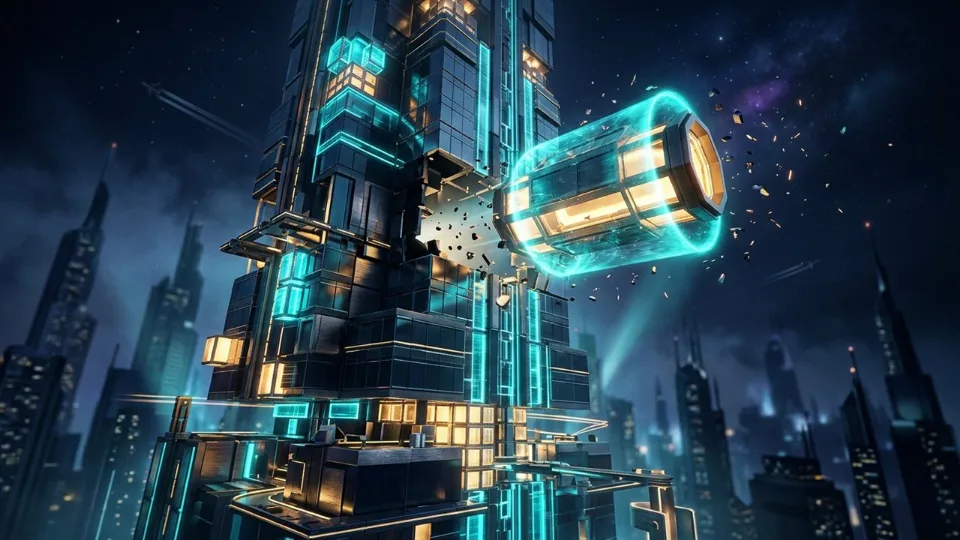
Reverse Builder inverts bridge physics: you dismantle blocks from a multi-story tower without letting the crown relic hit the floor or tilt past safe limits. Pulling lower pillars early triggers instant asymmetric torque collapse.
Press S to toggle the Stress Lens: cool/dim blocks carry near-zero load, whereas warm/red blocks act as primary fulcrums. Clear structures symmetrically from the top corners inward (left, then right) so the center-of-mass line stays centered inside the base.
Tension Cables vs. Compression Arches on Wide Canyon Spans
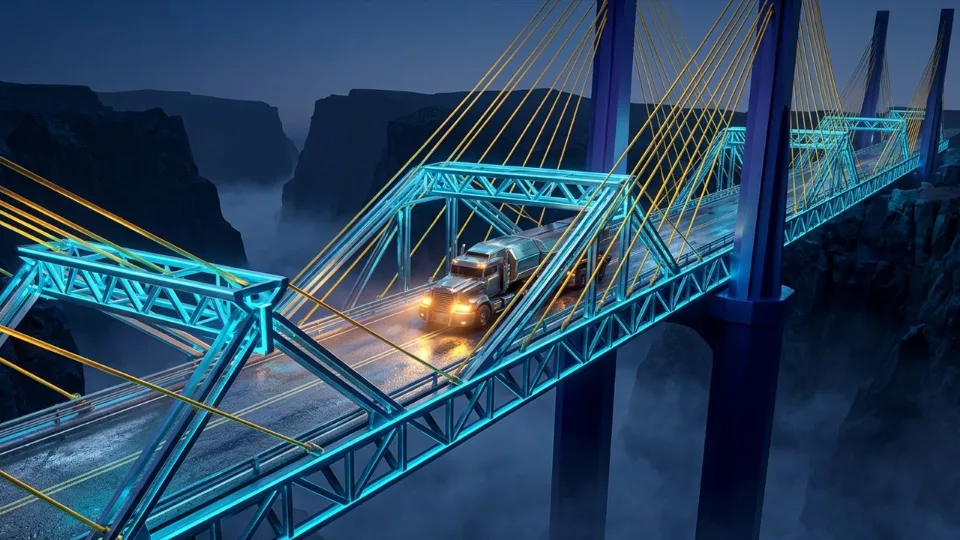
Once canyon widths exceed 6–8 road segments in Bridge Chaos, an overhead truss built purely out of rigid struts becomes so heavy that the bridge’s own self-weight (dead load) eats 70% of joint capacity before the vehicle even moves! That is where combining Key 3 steel towers at the cliff edges with Key 4 high-tensile cables shines.
Erect short rigid triangle towers directly over the cliff anchor pins (where rock walls absorb compression for free), then string lightweight tension cables (Key 4) diagonally to the center road nodes—halving sag and material spend.
Structural Physics & Material Roles in TekoGames Engineering & Balance Titles
| Structural Element / Game | Primary Force Handled | Failure Signature | Key Control / Tool | Budget Optimization Fix |
|---|---|---|---|---|
| Road Deck (Bridge Chaos) | Direct Tire Contact + Tension | Sags & snaps at center joint | Key 1 Road + Z Undo + E Eraser | Shorten segment length; add overhead triangle apex |
| Wood / Light Struts (Bridge Chaos) | Moderate Axial Tension/Compression | Buckles when too long (> 1.5x grid) | Key 2 Strut framing | Subdivide long diagonals into two shorter triangles |
| Steel / Heavy Girders (Bridge Chaos) | High Cliff-Anchor Compression | Blows stage budget if overused | Key 3 Heavy support | Use strictly on primary cliff-pin base legs |
| Suspension Cables (Bridge Chaos) | Pure Tensile Pull Only (0 compression) | Goes slack if pushed upward | Key 4 Tension cable | Hang vertical/angled drops from tall end towers |
| Load-Bearing Blocks (Reverse Builder) | Vertical Dead-Weight Stack | Topples keystone relic if pulled early | S Toggle Stress Lens · R Restart | Remove dark/green zero-stress roof blocks first |
| Center-of-Mass Stack (Stack Dash) | Dynamic Lateral Inertia | Overhang tips past base support polygon | A/D or Arrows / Drag counter-steer | Counter-steer smoothly before entering S-curves |
4 Concrete Structural & Balance Pro Tips
Keep Strut Segments Near Equal Length to Avoid Buckling
In 2D physics solvers, compressive buckling threshold drops rapidly as beam length increases. Two short struts meeting at a braced midpoint hold far more compression than one long uninterrupted diagonal.
Never Pull Asymmetric Base Supports in Reverse Builder
Even if a left-side pillar looks lightly loaded under the S Stress Lens, removing it shifts 100% of upper slab weight onto the right pillar, creating a rotational lever arm. Remove paired left/right supports in alternating steps.
Watch Center-of-Mass Projection in Stack Dash & Stack Rush
In Stack Dash and Stack Rush, tower stability follows the exact same support-polygon physics: 8 consecutive Perfect Drops in Stack Rush widen your base slab, restoring structural margin for faster upper tiers.
Step-Test Failure Frames Instead of Rebuilding From Scratch
Over-engineering every joint ruins your cost efficiency bonus. Build the leanest clean Warren Truss first, watch which single pin flashes red during crossing, hit Z Undo, and add one targeted brace right there.
Frequently Asked Questions
Why does my bridge break right before the car reaches the far cliff?
As the vehicle exits the final road segment, horizontal forward braking/traction plus concentrated axle load hits the last unbraced pin. Add a short diagonal strut from the far cliff’s lower anchor pin up to the final road joint before the exit.
What is the difference between Pratt Truss and Warren Truss in 2D bridge games?
A Warren Truss uses repeating equilateral triangles without vertical posts (simplest and cheapest for medium spans), whereas a Pratt Truss adds vertical posts with diagonals sloping inward toward the center so long diagonals stay in pure tension.
What does pressing S do in Reverse Builder?
Pressing S toggles the live Stress Lens overlay, highlighting high-compression load-bearing blocks in warm colors and safe zero-load blocks in cool tones so you never pull a critical keystone prematurely.
Can ropes or cables support weight from underneath a road deck?
No. Cables only resist pulling forces (tension). Placed underneath a road without a lower anchor pull, a cable goes slack immediately; always hang cables downward from elevated cliff pins or end towers.